
Practical Guide to Financial Due Diligence
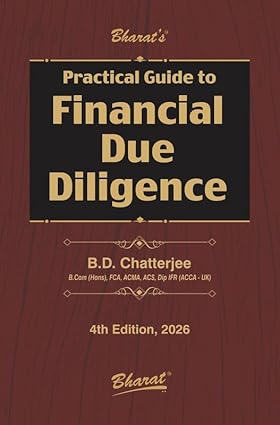
About This Book: Practical Guide to Financial Due Diligence (Fourth Edition) By B.D. CHATTERJEE
— It is a field-tested, end-to-end playbook for professionals who must make high-stakes deal decisions—fast, confidently, and with incomplete information.–
In today’s transaction environment, financial due diligence is no longer a checklist-driven compliance step. It is a strategic intelligence exercise—designed to uncover the target’s true economic engine, test earnings sustainability, expose value leakages, identify hidden liabilities, and sharpen negotiation leverage.
Drawing on decades of corporate leadership, transaction advisory experience, and regulatory insight, this book equips you with a structured methodology to evaluate businesses with a diagnostic lens—covering financial statements, cash conversion, working capital, governance maturity, contingent liabilities, distress signals, valuation linkages, and emerging dimensions like ESG and AI-enabled analytics.
Preface & Contents of the Book
What makes this guide different
This is not an academic overview. It is a practical, engagement-ready framework that explains:
• What to review (and why it matters)
• Which questions to ask
• How to spot red flags early
• How to translate findings into valuation, pricing, deal structuring, and post-merger planning
What you will learn (end-to-end coverage)
The book follows the full diligence lifecycle in a purposeful progression:
Part I — Foundations of Corporate Restructuring & Transactions
Understand corporate restructuring pathways, M&A frameworks, and the statutory ecosystem governing transactions.
Part II — Core Due Diligence Methodology
Master the due diligence approach, including seller-side and buyer-side diligence, scoping, workstreams, and the link between business strategy, processes, and financial diligence.
Part III — Deep-Dive Financial Diagnostics
A forensic, line-by-line approach to financial statements:
• Non-current and current liabilities
• Non-current and current assets
• Profit & Loss and Other Comprehensive Income
• Contingent liabilities and contingent assets
• Financial health, hygiene analysis, ratios, sustainability indicators, irregularities, and potential fraud symptoms
Part IV — Risk, Valuation, and Distress
Connect diligence findings to:
• Risk management
• Business valuation methods
• Distress analysis and distressed-deal considerations
Part V — Emerging and Sector-Specific Diligence Dimensions
Stay current with:
• ESG and dealmaking
• Industry sector patterns and risk themes across manufacturing, FMCG, healthcare, retail, infrastructure, start-ups, and more
Part VI — Technology, Analytics, and Real-World Application
Bring diligence into the digital age through:
• Artificial intelligence, predictive analytics, automation workflows, and AI-enabled risk dashboards
• Real-world case studies showing professional judgment in action
Ready-to-use tools included
Annexure I provides financial due diligence questionnaires and checklists that can be directly used in engagements—helping you standardize quality, reduce blind spots, and accelerate execution.
Ideal for:
• CFOs, controllers, and finance leaders evaluating acquisitions, investments, or restructuring
• Private equity, venture capital, and corporate development teams
• Transaction advisors, consultants, valuation professionals, and auditors
• Students and professionals who want the “real” diligence process beyond theory
Due diligence is not an audit. It is an investigation for informed judgment.
If your role involves evaluating businesses, protecting value, and making smarter transaction decisions—this guide belongs on your desk.