

Pocketbook of Project Management:
Project Planning, Evaluation and Financing
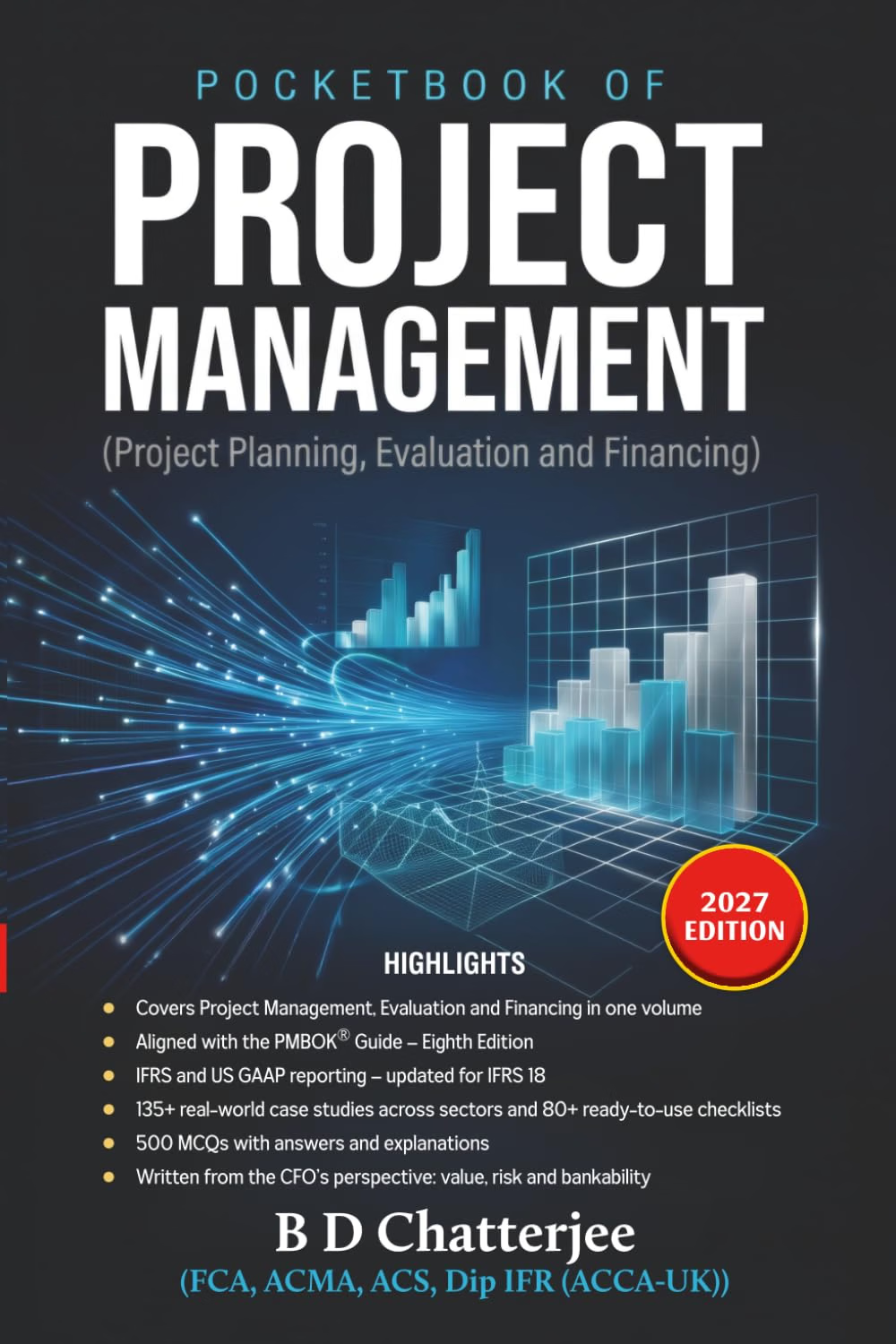
Pocketbook of Project Management: Project Planning, Evaluation and Financing
Why do promising projects fail even after careful planning, attractive financial projections, and management approval? Because success depends on more than meeting deadlines. It demands the ability to connect project execution, investment appraisal, financing decisions, risk management, and financial reporting.
Pocketbook of Project Management: Project Planning, Evaluation and Financing by B D Chatterjee is a practical, integrated guide to managing projects from concept and feasibility through delivery, financial close, operations, and exit. Written from the perspective of a senior finance leader, it bridges the gap between project managers, CFOs, investors, lenders & decision-makers.
ONE BOOK. FOUR CONNECTED DISCIPLINES.
1. PROJECT MANAGEMENT AND PLANNING
Master project initiation, scope management, Work Breakdown Structure (WBS), critical path method (CPM), PERT, project scheduling, cost estimation, budget control, earned value management (EVM), procurement, contracts, governance, agile and hybrid project delivery, and project risk management.
2. PROJECT EVALUATION AND INVESTMENT APPRAISAL
Understand capital budgeting and discounted cash flow (DCF) techniques, including NPV, IRR, MIRR, payback, cost-benefit analysis, sensitivity and scenario analysis, Monte Carlo simulation, real options, ESG evaluation, and public-private partnership (PPP) value-for-money assessment.
3. PROJECT FINANCE AND FINANCIAL MODELING
Explore project financing structures, debt and equity funding, capital structure, cash flow forecasting, bankability, financial modeling, debt sizing, debt service coverage ratio (DSCR), lender due diligence, risk allocation, credit enhancement, financial close, refinancing, and restructuring.
4. PROJECT ACCOUNTING AND FINANCIAL REPORTING
Learn how capital projects are reflected under IFRS, US GAAP, and Indian Accounting Standards (Ind AS), including borrowing costs, asset capitalization, leases, concessions, impairment, & financial disclosures.
PRACTICAL TOOLS, NOT JUST THEORY
Inside this comprehensive reference, you will find:
- Worked illustrations and industry-based case studies across renewable energy, infrastructure, healthcare, manufacturing, and technology.
- A fully integrated 500 MW solar project lifecycle case study, connecting planning, appraisal, financing, and reporting.
- Practical checklists, templates, dashboards, and a project finance and evaluation formula handbook.
- Multiple-choice questions with explanations, discussion questions, key takeaways, and a 160-question comprehensive assessment.
- Coverage of contemporary project management standards, including the PMBOK Guide, Eighth Edition, and developments in AI-enabled project controls.
WHO SHOULD READ THIS BOOK?
Project managers and PMO professionals; CFOs, finance controllers and treasurers; project sponsors and executives; bankers, credit analysts and investors; project finance and infrastructure consultants; and students or professionals studying project management, investment appraisal, and corporate finance.
A well-built schedule is not enough if project cash flows cannot support the debt. A positive NPV is not enough if delays and overruns destroy the expected return. This guide brings those decisions together so you can evaluate projects more rigorously, manage delivery with financial discipline, and understand what makes an investment viable and bankable.
STOP TREATING PLANNING, FINANCE, AND EXECUTION AS SEPARATE PROBLEMS.
Get your copy of Pocketbook of Project Management today & build the knowledge to plan smarter, evaluate investments with confidence, manage project risks, and finance projects with greater clarity. Turn promising project proposals into better-informed decisions and more disciplined execution.