

Pocketbook of IFRS for Energy & Infrastructure
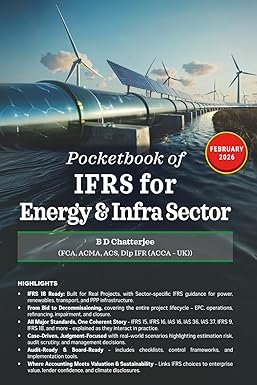
International Financial Reporting Standards (IFRS) are complex by nature—but their application becomes even more challenging in energy and infrastructure sectors, where long‑term contracts, heavy capital investment, regulatory frameworks, and project financing dominate financial reporting.
The Pocketbook of IFRS for Energy & Infrastructure Sector is designed specifically to address this challenge. It translates global IFRS principles into clear, practical, and sector‑relevant guidance for professionals working in power, renewable energy, oil and gas, utilities, roads, ports, airports, and large infrastructure projects.
This book bridges the critical gap between generic IFRS theory and real‑world application in capital‑intensive, regulation‑driven industries.
Why This Book Is Essential
Energy and infrastructure entities face unique accounting issues such as service concession arrangements, EPC and BOT contracts, power purchase agreements, regulatory deferral accounts, impairment of large assets, decommissioning obligations, and long‑term financing structures.
It provides a structured, concise, and practical reference that helps you apply IFRS accurately, consistently, and confidently—whether you are preparing financial statements, reviewing audit positions, transitioning from local GAAP, or studying for professional exams.
What You Will Learn
- Application of IFRS 15 Revenue from Contracts with Customers in EPC, PPP, BOT, BOOT, and annuity‑based infrastructure projects
- Accounting for service concession arrangements (IFRIC 12) commonly used in roads, ports, airports, and utilities
- Treatment of leases under IFRS 16 for power plants, transmission infrastructure, land use rights, and equipment
- Capitalization of borrowing costs under IAS 23 in long‑term project finance structures
- Impairment testing of large infrastructure and energy assets under IAS 36
- Fair value measurement under IFRS 13 in asset valuation and financial reporting
- Financial instruments and hedging under IFRS 9, including long‑term debt and derivatives
- Regulatory deferral accounts under IFRS 14, relevant to regulated utilities
- Provisions, decommissioning, and restoration obligations under IAS 37
- Consolidation, joint arrangements, and disclosures relevant to infrastructure SPVs
- Updated presentation and disclosure concepts following IFRS 18, replacing IAS 1
- Reduced disclosure requirements for subsidiaries under IFRS 19
- ESG considerations and sustainability‑related reporting relevant to energy and infrastructure entities
Key Features of the Book
- Sector‑specific focus exclusively on Energy and Infrastructure
- Clear summaries of IAS, IFRS, and IFRIC interpretations
- Practical illustrations and case‑based explanations
- Multiple Choice Questions (MCQs) for revision and assessment
- Global IFRS compliance checklist useful for audits and reviews
- Written in a concise, easy‑to‑navigate pocketbook format
Who Should Read This Book?
- Finance professionals working in power, energy, oil and gas, renewables, utilities, and infrastructure
- CFOs, financial controllers, project finance teams, and accounting managers
- Auditors, consultants, and valuation professionals handling infra and energy clients
- Students pursuing CA, ACCA, CPA, CMA, MBA (Finance), M.Com, or IFRS certifications
- Academicians and trainers teaching applied IFRS
Master IFRS for Energy and Infrastructure with clarity, confidence, and compliance.